From Disaster Response to the Dance Floor: How JP is Building Community with MovementPDX Festival
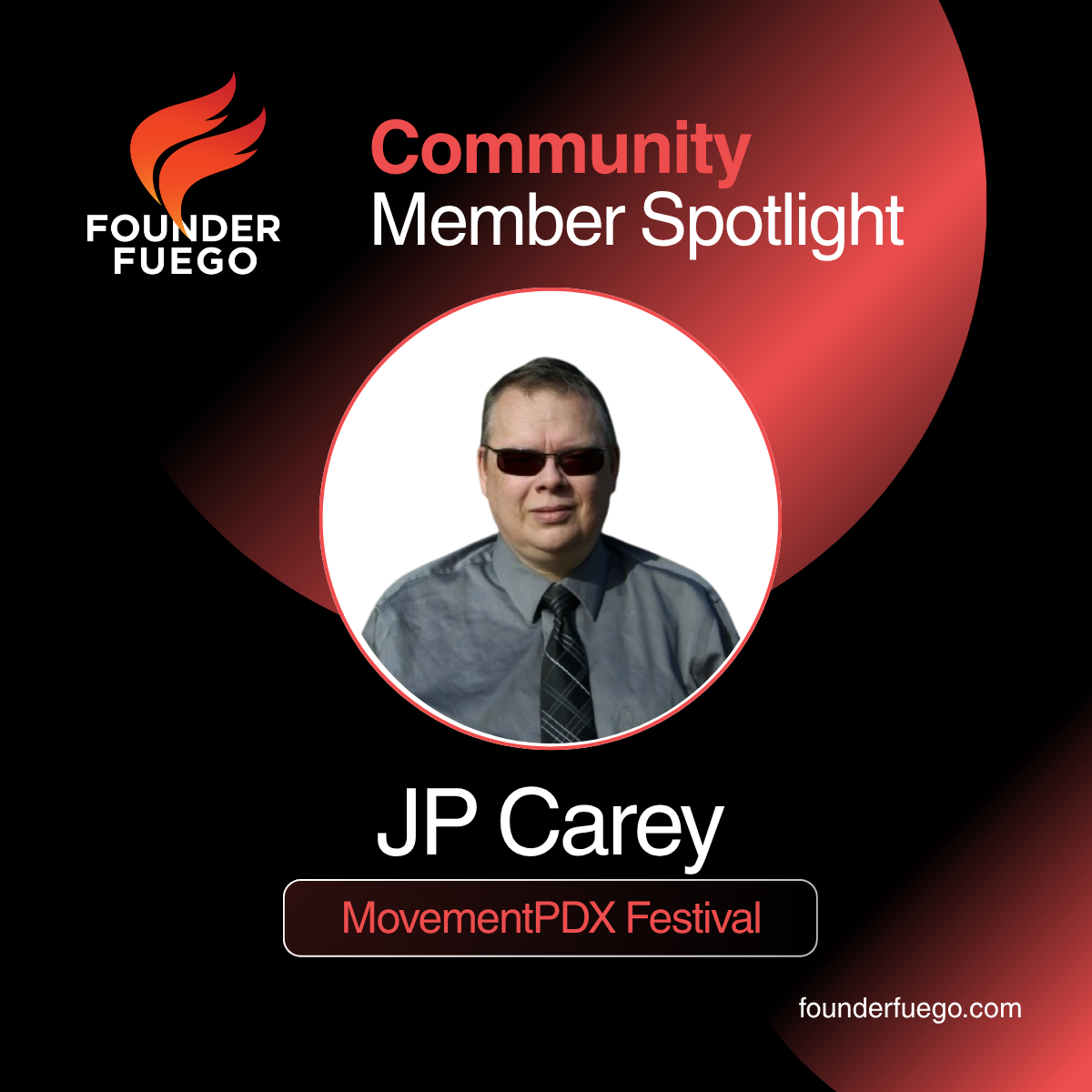
The Founder Who Responded to 11 Earthquakes Before Building a Music Festival
What does responding to earthquakes have to do with building a music festival?
For JP, more than you might think.
His path to entrepreneurship has taken him from Dublin to the Canadian military, from international disaster response to organizational continuity planning, and eventually behind the decks as a DJ and music producer.
Now, he’s bringing those experiences together as he works to build the MovementPDX, a music festival in Portland, Oregon, and strengthen the ecosystem surrounding independent artists in the Pacific Northwest.
At first glance, disaster response and electronic music might seem like completely different worlds.
Look closer, though, and there’s a common thread running through JP’s story:
People. Systems. Community. And what happens when you prepare people to step up rather than depending on one person to make everything work.
A Career Built Around Being Ready
JP was born in Dublin, Ireland and eventually served in the Canadian military.
His service took him into environments most entrepreneurs will thankfully never encounter. He deployed in response to 11 earthquakes and later spent years working with the United Nations as a mortician and tactical medic.
In those environments, preparation isn't theoretical.
People need to know their responsibilities. Communication matters. Systems have to work. And when circumstances change unexpectedly, the people around you need enough knowledge and confidence to respond.
Those lessons would follow JP long after his deployments ended.
He later entered the nonprofit sector, where his work included training volunteers to respond to disasters in their own communities and helping organizations think more intentionally about business continuity and Continuity of Operations Plans, commonly known as COOPs.
Eventually, that nonprofit reached the end of its own lifecycle.
Rather than keeping something alive simply because it had once worked, the organization was closed and dissolved, with remaining assets going to organizations including the Red Cross and organizations serving people experiencing homelessness.
There is something important in that chapter of JP's story.
Founders spend a lot of time talking about starting and growing organizations. We spend much less time talking about knowing when something has completed its purpose - and how to close, transition, or evolve it responsibly.
What Happens When the Founder Isn't There?
JP's work eventually evolved into an approach he calls Employee-Centered Continuity Planning.
The idea challenges a common assumption about organizational preparedness.
Instead of continuity living in a binder, with a consultant, or entirely inside the head of a founder or executive, JP focuses on training employees onsite and helping them understand how different aspects of the organization actually operate.
That means building knowledge across the organization so people are better prepared to respond when something changes.
At FounderFuego®, this caught our attention immediately given our work helping founders design businesses and nonprofits to function with them out of the day-to-day.
Because while JP comes at the issue through the lens of continuity planning, it intersects with a challenge we see constantly among founders, nonprofit leaders, and business owners:
What happens when too much of the organization depends on you?
When only one person knows how something works, that isn't simply an operational inconvenience.
It's risk.
Building an organization that can continue functioning through disruption requires more than documentation. It requires transferring knowledge, developing people, creating systems, and trusting others with meaningful responsibility.
Those lessons have become surprisingly relevant to JP's newest chapter.
From Continuity Planning to the Music Industry
JP isn't only a continuity professional. He's also a DJ and music producer.
And over the years, he began noticing something happening around him in the Pacific Northwest.
The region had lost several music promoters over the previous decade. At the same time, JP saw an opportunity for a major event serving an underground electronic music community that didn't have a regional festival filling the role that events such as MovementPDX have played in other markets.
Instead of simply asking why someone wasn't creating it, JP started working on the answer himself.
That became MovementPDX.
But his vision extends beyond putting artists on a stage.
JP sees an opportunity to connect music with tourism, community, LGBTQIA+ and BIPOC artists, professional development, and entrepreneurship.
Because being talented at making music and knowing how to build a sustainable career around that talent are two different things.
Artists also need to understand how to market themselves, develop relationships, negotiate opportunities, book themselves, and operate the business behind their creative work.
JP wants to help build that infrastructure too.
Creating a Pipeline, Not Just an Event
One of the most interesting parts of JP's vision is that MovementPDX isn't intended to exist in isolation.
He's developing an ecosystem around it.
One piece is a DJ training program to teach participants the technical skills required to mix music, but JP sees opportunities beyond the classroom. Graduates could become part of the broader community supporting future events, shows, and cohorts.
He's also envisioning a series of approximately club shows around Portland that could help develop an audience while giving emerging DJs opportunities to perform alongside national acts.
In other words, the festival isn't necessarily the beginning of the ecosystem. It can become the culmination of one.
Train artists. Create performance opportunities. Build audiences.
Develop partnerships and strengthen the local ecosystem.
Then bring those pieces together around a larger event.
That's a very different model from simply announcing a festival and hoping people show up.
The Hard Part: Building Infrastructure Behind the Vision
Of course, a compelling vision doesn't eliminate the difficult work of building it.
JP is navigating many of the challenges familiar to FounderFuego® Community members.
Fundraising. Marketing. Partnerships. Governance. Recruiting the right board members. Building an audience. And figuring out how to mobilize the people required to execute something significantly larger than one founder can manage alone.
He's launched a fundraising campaign and begun approaching major Portland employers and exploring employee-giving opportunities.
He has hundreds of existing industry relationships to activate. He's thinking about how other DJs can become collaborators rather than simply performers.
He's building out the marketing foundation.
And he's actively looking at what expertise needs to surround the organization, including board members with backgrounds that complement his own.
Eventually, executing the festival could require approximately 230 people.
JP cannot - and should not - be all 230 of them.
That's where his past and present come full circle.
The Same Lesson in a Completely Different Arena
A person who spent years thinking about what happens when systems are disrupted is now building something that will ultimately depend on hundreds of people knowing what to do.
The environment has changed.
The principle hasn't.
Build the people. Build the systems. Share the knowledge. Prepare the organization to operate beyond one individual.
That's true during a disaster.
It's true inside a growing company.
It's true in a nonprofit.
And it's true backstage at a music festival.
JP's story is also a reminder that entrepreneurship doesn't always follow a straight line. The experiences that seem disconnected at one stage of your career can become the exact experiences that differentiate what you build next.
A military deployment can teach you about systems. Disaster response can teach you about preparation.
Nonprofit leadership can teach you about mission and transition.
Continuity planning can teach you about reducing organizational dependency.
DJing can introduce you to a community and an industry.
And eventually, those experiences can converge into an idea that probably couldn't have been built in quite the same way by anyone else.
What's Next for JP
JP is still building. MovementPDX is not the finished chapter of this story. It's the chapter being written now.
There are partnerships to develop, funds to raise, board members to recruit, audiences to grow, artists to support, and a substantial operational infrastructure to put in place.
And that's one of the reasons we wanted to feature JP now.
Community Spotlights aren't only about celebrating entrepreneurs after everything works.
They're about recognizing founderswhile they're in the arena building it.
We're excited to see how JP continues bringing together his experience in preparedness, continuity, music, education, and community as Portland Music Festival takes shape.
Because sometimes entrepreneurship begins with a completely new idea. And sometimes it begins when you look across everything you've already done and realize:
You've been preparing to build the next thing all along.
Learn more about MovementPDX Festival, volunteer to lead on the board, and donate to his mission here:
MovementPDX 2028 - Electronic Music Festival | Portland, Oregon
🔥 Want to meet founders like JP and build alongside business and nonprofit leaders working through the same questions of growth, funding, partnerships, and founder dependency?
Join us at the Built Beyond You™ workshop where you’ll learn what to prioritize doing next so you get not only the guidance but also the execution fire power to make it happen.
Join the FounderFuego® Community and come build what's next with us.
Join our upcoming Founder Dependency Workshop™ to help you get out of the day-to-day of your business or nonprofit.
Tune in to the newsletter to hear more inspiring founder stories.